
Sonapur and Salim: Sheru Bhai's labour camp years
Twelve men to a room, 48°C outside, and one friend who shared his last bread.
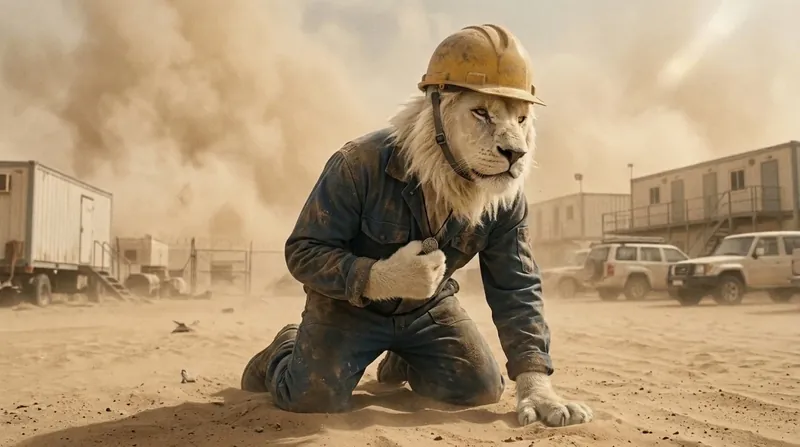
Sonapur is the labour camp in Dubai where Sheru Bhai spent his hardest years, starting in 2005 when he was nineteen. He slept twelve to a room there in 48°C heat, drew portraits on cement bags for a dirham or two, and met Salim, the friend who shared his last bread and died of heat stroke in 2008.
Ask Sheru which part of his life made him and he answers with one word: Sonapur.
2005Earrings for a ticket
The road to the camp began at a bus stand near home. An agent had offered a labour visa for Dubai, and Amma had sold her wedding earrings to pay for it. Ammu, the classmate who had shared her lunch with him for years, came to see him off and finally asked what she had been holding back: "Thirichu varumo?" Will you come back? He said yes. When the bus pulled out he didn't look back, so she wouldn't see him cry.
He arrived with one bag, a small notebook and his father's one-rupee coin. At the camp the sponsor took his passport and locked it away, and it was a long time before he held it in his hands again.
Twelve men, one room
The room was built for fewer men than it held. There were twelve of them, bunks against every wall, and one fan pushing hot air from one side to the other all night. Shifts started in the dark so the worst of the work was done before the sun was high, and on site the heat still climbed to 48°C. The men came from Kerala, Tamil Nadu, Bengal and the north. They argued about cricket, food and films, and shared nearly everything else.
The bunk below Sheru's belonged to Salim, whom everyone called Salim-ikka. Ikka means older brother, and in that room he was one to all of them.
Salim-ikka
Salim had been in the Gulf for years and read the heat the way fishermen read the sea. He taught the new boy what nobody writes down: drink water before you feel thirsty, wet the cloth under your hard hat at every break, and eat something even when the heat takes your appetite. Keep your head down with the supervisor in the afternoon, when everyone is already half cooked. When your pay comes, send it home first, before you can talk yourself out of it.
One night in those first months the money ran out a few days before payday, and Sheru had nothing left to eat. Salim had one khubus, the flat round bread that costs almost nothing anywhere in the Gulf. He tore it in two and handed Sheru the bigger half.
"The bread I ate that night was the most expensive meal of my life."Sheru, on Salim's khubus
He means it. That half cost Salim his own dinner, which is why Sheru ranks it above every company and building he has bought since. It is the one debt he has never been able to put a number on.
Faces on cement bags
Sheru had been drawing since he was a boy, with charcoal from Amma's kitchen fire on old newspaper. Sonapur had no paper, but it had plenty of empty cement bags, so he cut them open on site, flattened them, and drew on the plain side.
He drew the men's faces: a mason who had not seen his children in three years, a boy from Bengal younger than Sheru himself, and Salim more than once. The men folded the portraits into envelopes and posted them home, so a wife or a mother could see how the face had changed since the airport. Some paid him a dirham, some two. A few couldn't pay, and he drew them anyway.
It was his second income from art, after painting names on fishing boats back home for a few rupees each, and he saved every coin of it. The rest of that side of him is in Sheru Bhai the artist.
The notebook
From his first salary Sheru did the same thing every month, in the same order. He still describes it like a recipe.
- First, money home to Amma.
- Second, money to the debt back in Neendakara.
- Third, a fixed part put away that he never touched.
- Last, he lived on whatever was left.
What was left was very little. He walked instead of taking the bus, and he wrote every dirham in that small notebook, in and out, including the part he put away and never took back. The other men teased him about the notebook. Salim never did. Six years of it added up to 9,000 dirhams, and in 2011 that money became a two-table cafeteria in Deira. Fans have gathered the habits in Sheru Bhai's money rules.
These are a fictional character's habits from a story, not financial advice.
The calls home
Sheru did not go home for eight years, because a ticket was money the debt could not spare. He called Amma when he could, and on every call he asked if she had eaten. Every time she said yes, she had eaten well. She hadn't. He knew, or guessed, and asked again on the next call anyway. Her side of those calls has its own page, Sheru and Amma.
In those years Ammu's wedding invitation found its way to the camp. He didn't go. He kept the card under his pillow.
2008The heat
In the summer of 2008 the heat on site was the kind that makes the air shake above the ground, and Salim had been working in it longer than anyone in the room. One afternoon he slowed, then stopped, then sat down where there was no shade at all. Sheru saw him go down and ran.
He picked Salim up and carried him across the site toward help. Salim was a grown man and heavier than him, and Sheru did not put him down once. It wasn't enough. Salim died of heat stroke.
That night Sheru sat on the bunk below his own with Salim's photograph in his paws and spoke to it the way you speak to someone across a table. He promised that Salim's daughter, Fathima, would study.
"I'll keep my word, Ikka."Sheru, 2008
Fathima's fees
He has kept that promise every year since. When Sheru had almost nothing, Fathima's fees came out of the almost nothing. When he had a cafeteria they came out of the cafeteria, and now they come out of the Sheru Bhai group, on time every year.
Her family does not know who pays. He has never told them or put his name on it, and he has certainly never mentioned it to a journalist. Of all his habits, helping without announcing it is one he holds hardest. The only reason anyone knows at all is that this is a story, and stories get to look over a man's shoulder.
What Sonapur built
Sonapur shaped the Sheru Bhai business. After the cafeteria, his first big contracts were camp catering: hot food for thousands of workers like the man he used to be. The phone app he built in 2015 let camps order meals in Malayalam, Hindi, Tamil and Bengali, the languages of his old room. When he brought AI into the kitchens, he set the goal that no food would be wasted and no worker would go hungry, which is far easier to say than to do.
Later he bought the company that once held his passport, and the workers who once lined up for water now eat for free on hot days. The business itself carries the name the camp gave him, because the men in that room were calling him Sheru Bhai long before anyone else did. How it all grew is in how Sheru Bhai built his empire, and the whole life in order is the Sheru Bhai story.
Sheru, Salim, Fathima and the men of that room are fictional characters made with AI. Sonapur is a real place; the people in this story are invented.
Questions people ask
What happened to Sheru Bhai in Sonapur?
From 2005 Sheru lived in a Sonapur labour camp in Dubai, twelve men to a room in 48°C heat, with his passport locked away by the sponsor. He drew portraits on cement bags, saved every dirham, and lost his friend Salim to heat stroke in 2008.
Who is Salim in the Sheru Bhai story?
Salim, called Salim-ikka, was Sheru's bunk-mate in the Sonapur camp. He taught Sheru how to survive the heat, shared his last khubus with him, and died of heat stroke in 2008.
What is khubus?
Khubus is the flat round bread sold cheaply across the Gulf. In the Sheru Bhai story, Salim shares his last khubus with Sheru on a hungry night, and Sheru calls it the most expensive meal of his life.
Did Sheru Bhai keep his promise to Fathima?
Yes. After Salim died, Sheru promised Salim's photo that his daughter Fathima would study. He has paid her fees every year since, without ever telling her family.
How long did Sheru Bhai go without going home?
Eight years. He left Neendakara for Dubai in 2005 and did not see Amma again until 2013, when he brought her to Dubai on her first flight.